Does a College Degree Protect your Career? Unemployment Rate for College Graduates Highest on Record.
- 40 Comment
As many students begin applying for the 2010 academic school year, students are looking at an economic climate where endowments are hit, student loans are more restrictive, and parents have seen 529 plans sink along side their retirement plans. The upcoming school year will be highly competitive and expensive but will it be worth it? Now college itself isn’t a direct link to a career and many bristle when they hear about vocational training. Yet when someone is paying $50,000 a year, you have to ask what exactly you are paying for.
With the recent unemployment rate hitting 9.7 percent officially, the wider ranging U-6 rate hit a record of 16.8 percent. The market took the 216,000 job losses as good news but the recession is much deeper than the headlines are showing. If you dig deep into the report, you will find a few curious observations. First, the teenage unemployment rate is the highest in nearly half a century coming in at over 24.2 percent. Now this rate is always high but only in August of 2008, it was at 17.8 percent. Another observation in the report that we find is those with college degrees are facing the highest unemployment in two decades since records started being kept.
With college costs going through the roof and in many cases, costing nearly $50,000 a year at private schools many are asking whether some college degrees are even worth pursuing. Or more importantly, potential students are seeking answers regarding value. Let us look at this trend more closely:
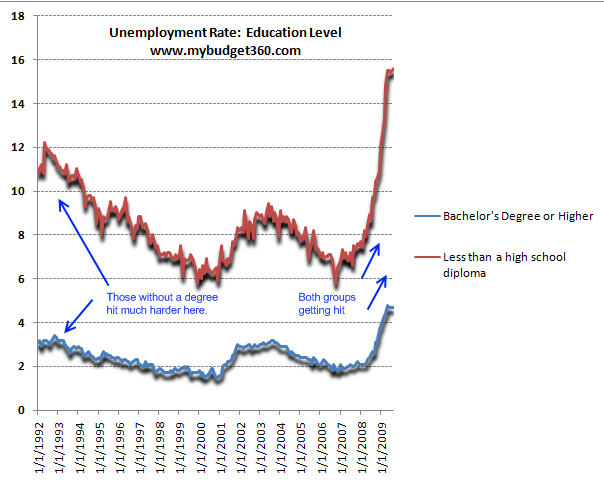
You’ll find a curious trend here. Without a doubt, those with a college degree do better in the marketplace. Take a look at the recession in the early 1990s. A college degree seemed to be a better buffer at that time than our current recession. For the first time in record keeping history, the unemployment rate for those with 4-year degrees or higher has passed the 4 percent mark. Keep in mind that in the United States, only one in four has a bachelor’s degree or higher. We tend to think of this group as largely immune but in deep recessions like this one, a college degree no longer protects you from the fluctuations of the market. An education through online schools will not protect your career either.
The massive increase in college tuition needs to be explored. If you think about someone going to school to pursue a career in say social work, a noble career, is it really worth it to go into $100,000 to $150,000 in debt for a career that pays $30,000 to $40,000 a year? In a situation like this, a student may benefit by going to a lower priced state school instead of a private institution. Certainly many will go to top schools simply because of the implied pedigree of an institution especially if they want to enter into the top law firms or seek higher positions in certain corporate sectors. Yet many are realizing that too much college debt is not a good thing.
If you think this isn’t the case, just look at how many people are having trouble paying their student loan debt. Red means conditions have worsened and this is for 90+ days late year over year:
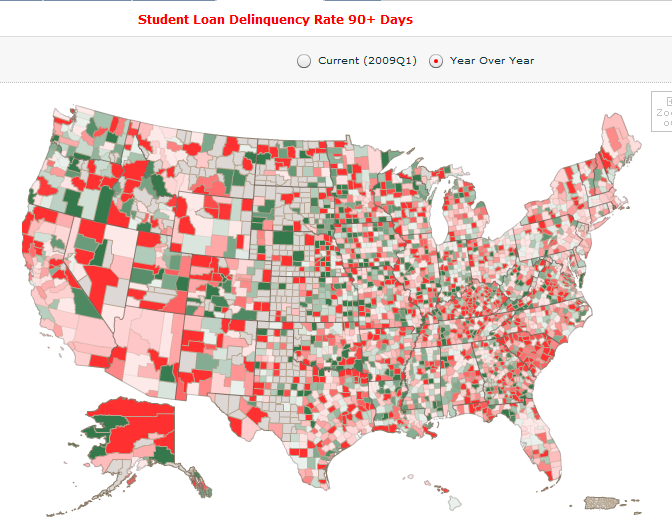
If you look at the population centers of California, Florida, Texas, and New York student loan debt has worsened practically in the entire state. Clearly the current economic recession has much to do with it but also, the fact that those with college degrees are losing jobs in large numbers as well. Many are no longer able to service their own debt. As we have mentioned, a college degree does not protect your job nor does it assure you in getting one. Some are even suing because of this:
“NEW YORK (CNN) — A recent college graduate is suing her alma mater for $72,000 — the full cost of her tuition and then some — because she cannot find a job.
Trina Thompson, 27, of the Bronx, graduated from New York’s Monroe College in April with a bachelor of business administration degree in information technology.
On July 24, she filed suit against the college in Bronx Supreme Court, alleging that Monroe’s “Office of Career Advancement did not help me with a full-time job placement. I am also suing them because of the stress I have been going through.”
What I find troubling is the idea that simply attending college is the ticket to a job. Also, what is more disturbing is many of the for profit institutions with no pedigree try to push people through to continue getting those nice loan checks each semester:
“In her complaint, Thompson says she seeks $70,000 in reimbursement for her tuition and $2,000 to compensate for the stress of her three-month job search.
As Thompson sees it, any reasonable employer would pounce on an applicant with her academic credentials, which include a 2.7 grade-point average and a solid attendance record. But Monroe’s career-services department has put forth insufficient effort to help her secure employment, she claims.
“They’re supposed to say, ‘I got this student, her attendance is good, her GPA is all right — can you interview this person?’ They’re not doing that,” she said.”
Good attendance? A disciplined worker with no college degree can be punctual 2.7 is not an “all right” GPA. The problem now is that we have someone with “subprime college debt” of $70,000 and no viable job prospects. It would be different if they had only say $10,000 in debt but $70,000 is simply incredible. And how many people are graduating like this into a terrible recession where employers have their pick of potential applicants?
The U.S. Treasury and Federal Reserve seem willing to bailout any mistake so it should be no surprise that students expect bailouts as well. They are simply following the lead of our central bank. It is also a question of what degrees are being awarded. While we had many chasing degrees in finance to pump out paper to increase the housing bubble, globally other nations focused on making actual things:
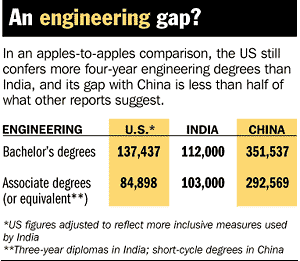
Source:Â CSMonitor, 2005
Even after adjusting lower, we can see why things will remain tough. The globe is hyper competitive now. Many entering college now face the challenge of examining what they want to do with their lives but also, dealing with the economics of a new financial age. A college degree was never a guarantee of a job or career security and this will only become a stronger rule in the future.
If you enjoyed this post click here to subscribe to a complete feed and stay up to date with today’s challenging market!
40 Comments on this post
Trackbacks
-
RICHARD RALPH ROEHL said:
It seems that most colleges and universities in the United $tates have become glorious [sic] football teams… more than institutions of higher learning. This is why college coaches, especially footballing coaches, earn six and seven figure $tipends ANNUALLY… whereas the physics professor earns peanuts and pissst water wages!
Furthermore… the current economic $ituation is making a mockery of having a college degree. Or two or three degrees. Indeed! The ever increasing cost of time and money to acquire a college degree seems a feckless and burdensome excercise… done more for the $ake of eeego than common $ense.
These days/daze… it makes much more common $ense to pursue a useful vocational $urvival $kill that’s wanted and needed by society. I need a plumber and a car mechanic… more than I need someone with a degree in correct-arse feminism… or crony banksterism… or perhaps some other $cam profession.
Wake up! See what has happened to colleges and universities in the United $tates since the 1960’s. See it!
September 6th, 2009 at 4:08 pm -
Carol Harris RN said:
I graduated in 1958 from a hospital nursing program. I have always
been employed until I retired. I have an AA degree and was a semester short of a BSN. I know that nursing is hard, but there
are many perks. If you come out of a 2 year program, most hospitals will pay your tuition for a bachelor’s degree. You can
get an LPN license after one year. LPN’s are making $25.00/hr in
my area in nursing homes. Nurses make about $60.00 a year in my
area in Charlottesville, VA. It is true that all of those science courses are “hard ” for some folks, but you will have a job. Most
nurses in my area work three twelve hour shifts and have four
days off a week.September 6th, 2009 at 11:32 pm -
PSzymeczek said:
Got my Master’s to get the heck out of the switchboard in civil service. 19 years later, I was fired from civil service for no good reason.
September 7th, 2009 at 10:17 pm -
Terrance Stuart said:
Higher Education is a business. Generally, the first two years are a rehash of what you should have learned in high school. A two year college usually can provide you those classes economically.
If colleges and universities were held to the same standard as pharmaceutical companies they should be required to give a warning to students that the course work they choose to take is no guarantee of future employment.
A short trip to careerstop on the web will allow you to drill down to the statistics on what is needed in the job market, what the range of salary is, and so forth.
We have obviously moved way past the notion that higher education is strictly for the sake of learning. Speaking of China, mnany of their so called engineers are not trained to the levels ours are, and they are still retiring k-12 teachers who could teach the 6th grade because they had attended the 6th grade. So the credentialing in China may be suspect.
The final truth is college graduate unemployment is at an all time high, but it remains lower then non-college employment. It is also interesting that in recent years females are surpassing males in numbers as college attendees and graduates. Strong vocational training may be more more valuable then many academic fields in the future, as energy prices may re-industrialize this country as the “global economy” may become a lot more localized by necessity.
September 8th, 2009 at 9:43 am -
John said:
An expensive 4 year college degree is worth it as long as you choose the correct major. I graduated as an electrical engineer with significant coursework in Finance in May of 2008 and I have a great job at a Bank. But classmates of mine with art history majors are surprisingly unemployed. Perhaps if they had thought about their job prospects 4 years earlier then they would have realized that their major was only for their own satisfaction.
November 2nd, 2009 at 7:35 am -
Sam Hill said:
College degrees have become overvalued. The education bubble.
It does not guarantee a job or a salary. If you take out a college loan
for a degree. There is a extremely good chance that the yearly salary you obtain will not be sufficient to exceed the cost of the degree in 10 to 15 years. Possibly longer. With two degrees I have been out of work for 24 months.November 13th, 2009 at 10:12 am -
Patrick said:
As a foreign national, who holds multiple US degrees, I have realized
that here in the US, it is not the years that you study that matter, but rather the difficulty level of your studies. Most Americans do not like challenging courses in science, math or chemistry. Americans love the easy stuff like a JD. Anyone can become an Attorney; you only need to be able to read and write. For Healthcare careers you need to know and understand science, something that requires the use of your cerebral cortex.For instance, a dental Hygienist, who only requires a 2 year associate’s degree, can easily make more than an attorney (a 7 year degree, plus 6 months of taking and passing the bar). How can this be possible? ECO. 101- Law of supply and demand. For instance, in FL there is way over 90K attys vs. less than 8 registered dental hygienist. Thus, a RDH can easily command a salary of $35.00 an hour, when working for a Dentist. An associate attorney in FL will normally get paid $25.00 to $30.00 per hour (unless he is working for an elite law firm or handling Personal Injury cases). Do the math; if you want to become an attorney, you will need to spend as a minimum $150k, not to mention the opportunity cost of not working for 5 years. For a RDH, you can go to a public school and spend $5K at the most, and you will not forgo the salary of 5 years-the additional amount of time that would require becoming an atty.
January 20th, 2010 at 9:59 am -
Patrick said:
Please note that the data in this article only shows Bachelors Degees for Science, which is irrlevant for high paying jobs, and or serious scientific research. NSF data reveal that in 2005, the foreign student population earned approximately 34.7% of the doctorate degrees in the sciences and approximately 63.1% of the doctorate degrees in engineering.
January 20th, 2010 at 10:43 am -
Patrick said:
FYI–NSF is National Science Foundation
January 20th, 2010 at 11:09 am -
Francesco said:
who decides to invest all that money in higher education must collect infos about the job market consider what employment possibilities there are and where they are.this means choose carefully your major and consider that u have to sutisfy the needs of the market and not viceversa.and dont forget another relevant factor..there are other thousands of students competing for the same job so when you choose your university and spend all that money,please be smart enough to not loose yourself in the childish campus life and work hard to be the best..possibly working part time on the side to learn the value of money.i’m from europe and you can bet that most students here extremely determined to fill the lack of “prestige” of the avarage european university with their strong commitment and their own sense of responsability.they kick their asses,working and studying,for mami and papi are not there financiating all that superfluous “campus life”.yet they graduate with excellent netes and come to your country to end up probably finding a better position than yours.i think the moral here is only one…work hard to be the best and you’ll be rewarded.welcome to the global market
January 25th, 2010 at 2:48 pm -
JP Merzetti said:
I wonder what kind of college-graduated employment results would exist had we the economy of 40 years ago.
Back then….seemingly worthless degrees put people to work. They still had some semblance of skills related to whatever jobs they could get and keep.I believe this is all smoke and mirrors….if every single person who earned some post-secondary parchment had astutely hand-picked the perfect course of study in high demand (with extraordinary 40-40 foresight!) they’d still discover that probably about 40% of them were out of luck – not enough jobs to go around.
We may as well resort to some authoritarian state-sanctioned streaming system where every grade 8 graduate is told in no uncertain terms exactly what field they are best suited for, and that’s what they’ll do.
Even then, we couldn’t employ them all.The system is breaking down…..the only reason people go to college is to get the education which will lead to employment which will allow them to achieve at least a middle class attainment.
The small percentage of those who get an education for any reason different than this, hardly fit into the larger picture.It is not only a waste of human lives and potential, but a ridiculous waste of education as well, when so much of the work people end up doing has absolutely nothing to do with their education.
Nitpicking about the tiny minority of perfectly placed matches representing plum jobs for highly trained technical or financial wizards, ignores the three quarters of the entire population who will never fill such shoes. What to do with them? Who knows………
– but seriously, those “left-outs” are the ones who will supply much of the so-called buying power that beefs up what is left of our sadsack GDP. Something to think about.
March 24th, 2010 at 8:38 pm -
Lilly said:
To Patrick:
I see your point about dental hygiene vs. law degree, but I think you did not do enough research and you might confuse a lot of people. A dental hygiene program is not 5k at a public school, the college website will tell you is about 12k not counting instruments, and a lot of materials which are expensive (dentistry is not a cheap field). Also the program is very intense, and by intense I mean very intense. It is not exactly 2 years since you do have to take some general classes, just not as many as you would need for a AA degree… but overall you take more college credits than a simple two years AA degree. Also since the classes are very intense you can expect to pretty much be in school Monday thru Friday from 8am to 5pm (on Fridays until 12noon), and a lot of the classes give you 1 or 2 college credit but you have to study much harder and spend a lot of time at school.
On top of that, jobs for dental hygienist are scarce, specially in Florida. You do have to pass 2 board exams to get your license. And for the most part you do not start at $35 an hour unless you are being hired by your own dad. Also recent graduates usually have to network and volunteer to get jobs, and many start at $24-26 working only 1,2 or 3 days a week (an attorney will have a job everyday and thus will make much more money). Last, the job is very taxing on the body, and I mean you don’t need years in practice, the first clinic all the students were in pain. You have to take really good care of your body if you want to be in this profession.By the way, I am graduating from hygiene school in 2 weeks.
April 19th, 2010 at 3:24 pm -
wardoc said:
Has anyone else noticed all the ads for “higher education,” from on line degree programs to local colleges. They’re all begging for students.
Before this depression is over, less that half, maybe less than 10% of all “higher ed” institutions will be gone. Kids need to start looking at trades anyway, so good riddance.May 1st, 2010 at 2:40 pm -
Baylor Bear said:
Trina Thompson can not expect to get a job through career placement services. She has to network and build relationships with people before she can get anywhere. I have been without a job for 6 months. I have a much higher GPA, went to a better school, and live in a market with more job opportunities. She is falling victim to a major problem with our generation. We want a lot to happen with little effort, and we want it immediately. The general rule is for every $10,000 in salary expect that many months to find a job. IT professionals in New York get paid about $60,000, so that means she should wait at least 6 months.
May 25th, 2010 at 7:31 am -
Barbara Saunders said:
One problem with analysis like this is that none of the relevant categories are properly controlled. What college graduates are we talking about: community college vs. Harvard; Harvard vs. state schools? Are we talking about C-students going to just any college to get a degree? How about people who qualified for Harvard but went to the JC to save money?
Then there’s all of the – excuse my French – b.s. about which majors lead to jobs. Is it really true that business majors from DeVry do better than English majors from Tufts?
For my fellow Gen-Xers out there: how many of you are still working in a field directly and obviously related to your major? Even trickier question: how many of you are using what you learned every day in a field that common wisdom does not connect to your major (e.g., high-performing sales person who “doesn’t use” the English degree, or the anthropology degree)?
There are simply too many variables for this repeated exercise about “what college is worth” to help most individuals in making life decisions.
June 10th, 2010 at 1:18 pm -
Nick said:
I blame lots of things for this mess. First Outsourcing. All of the American white color jobs have been outsourced to India and China. Corporations love cheap labor even when they break humanitary laws. At least the people of China are waking up and demanding higher wages. India I’m not so sure about as they are followers and they can’t do anything on their own. They like being corporate puppets and Corporate America loves them for that (based on my experiences they get at Job Fairs/Corporate Meet N’ Greets). I dont know why Congress/Senate/Obama waited until now to create the “American Job Creation and Fix Tax Loopholes Act of 2010”. Obama when he was campaigning in 2008 said he was going to stop tax breaks to companies that outsource jobs overseas and give tax breaks to companies that hire American workers. But he’s a politician and they are very good actors to get your vote. If he would have not waited on his promise until now and then him following up with the stimulus we I think would have been out of this recession (*cough*depression*) by now. Do some research (and not just the headlines) and you will find the truth.
Then theres the media. It seems since the late 1990s is when I heard tons of hype on the major news networks like CNN saying the “value of a degree”. I was hyped when I graduated from high school, thinking Ill finally be out of living in poverty once I get my degree. I’m now in more poverty and I am hoping I can do bankruptcy for my student loans (If the House/Senate will allow it in upcoming sessions)
Oh and Patrick, I have the exact same degree as the girl who is filing a lawsuit. I know the main aspects of Business and I also know very complicated scientific technologies that involve computers. I know how to program, make and administer databases, maintain networks,ect. And I have a legit passion for these things. I killed myself in school to graduate from college and it was (and still is) very devastating being unable to find a job in my field 2 years later. I’m still going to hang in there as long as I can and not give up. But also, I am finally starting to accept we are in the Great Depression II and it will probably take years (5-10 or longer) before we fully recover.
Again, I mainly blame the outsourcing for this mess. Once the senate undoes what Bush signed into law in 2004 (which gave tax breaks to companies that outsourced American jobs overseas) I think things will hopefully turn around.
Also, I think there is a new bubble about to burst, the student loan bubble. Once it bursts anyday now I think there will be an end to the 10 years of hype for a college degree. It already seemss to be accepted in society that going to college is very risky as the costs keep going up, private loans are getting scarce, and there are no jobs for people with college degrees. Maybe then we’ll get a 10 year gap of college graduates and this can balance all of the baby boomers hogging up the jobs for the newer graduates.
But also our recovery will have to due with the dumb voters who fall for what Corporate America and the GOP has always thrown at us to try and make Obama look bad. He’s not great, but he’s a step in the right direction for America. And he is doing the best he can with what he inherited from Bush. And American voters must not forget what the Republicans have always done to this country (especially how it is today) and its economy by how they have destroyed it.
June 19th, 2010 at 2:55 am -
Nick said:
Also, Baylor Bear. About Networking. How are you suppose to network if you dont know many people. You can’t hold onto your high school/college friends to get you jobs forever.
Networking IMO is a very poor way to pick someone who is the most qualified for a job. I have known programmers who didn’t know a subroutine from a submarine and they got a job.
I have noticed overly the last 10 years there are lots of mistakes being made in companies and the quality of work America once had has gone down drastically.
Look at BP,Enron,Goldman Sachs,Lehman Brothers, ect.
June 19th, 2010 at 3:05 am -
DL said:
School is a Business. Pay to enroll and get a seat.
Sadly most of the Admin Staff and instructors do not care to do
a good job of teaching you,care if you learned anything or if you can get a job. Since the school already got your money upfront, the instructors can get lazy and teaching efforts go downhill after the drop date. Nobody is in the room monitoring the attitude of the instructors. Instructors only care about their own paycheck, are rude to the student. Students are the customers because if their were no students , School Admin, counselors, instructors would not have jobs.I have asked an instructor about her course and she actually told me she needed to go home and water her plants. Her college syllabus was so full of typos and we had to call her Dr. cause she had a masters degree. Another college instructor never ever really read the $150. textbook she made the class buy because all her homework and tests were from the knowledge in her head. Reading the book didn’t do any good because she never followed it and the only reason she picked the $150. book was because it was a teaching requirement. Who cares about the student’s wallet and that they bought the book for nothing.
I have had admin people loose my education documents and given wrong information about the school process many times. I’m glad they are laying off teachers since a lot of them are lazy because they feel that their job was Union secured so they don’t put much effort to actually teach the students. Computer software teachers just give you a book and you read the book and teach yourself. God forbid you have a question and they have to their lazy butt up from their desk to help you. The answer when the got instructor got to my desk was “I don’t know, What did you do, Go back and read the book. I thought instructors are suppose to know in depth about the subject they are teaching.The school system has become such a joke. Getting a degree does not have the same value as it use to hold in the 50s and 60s. We get degrees for our own egos so that we can brag that we have a degree made out of paper. At least it could of been made of gold so we can sell it and buy food if we can’t get a job.
July 18th, 2010 at 10:53 am -
Nes said:
I think the economy was headed down the tubes years ago. It’s not a great time to be a college Grad. I can’t believe I had so many arrogant professors, who offered office hours with little assistance because all they cared about was their research. Yes the Degree system has little value theses days.
I had an instructor that stated that if she found any students copying of books, she would turn the students in, because it is illegal and those are her friends who wrote the $132.00 text book, so she will make sure they get all their money..what a jerk…so much for helping the students.. I so agree that we just need to accept that we are in a great depression and keep pressing forward by getting more trainning and maybe attending some networking events that may put us in the right direction.July 29th, 2010 at 6:26 am -
Jacob said:
What in the world?!?! Look folks… the reason why many of you are unemployed or why you fail to find work quickly is probably because you are lazy, incompetent, entitled, or because you simply will not move to take a job somewhere that isn’t close to home for you. Please note that having a college degree does not make you competent. There are lots of folks who spend four or five years in school and come out dumber than a box of rocks. There fact is that there are a TONNNNN of jobs open across this country right now. I’m a 29 year old MBA graduate from an unranked school. At 17 I joined the military, finished college, and earned a commission. After 9 years on active duty (in 2008) I resigned and found a job as a project manager for a Fortune 500 company within 30 days. I was hired two weeks before my last day in the service. Last year I applied for more senior positions with 6 different companies. Within 2 weeks I had offers from all of them. Last week I applied to three new companies for an even more senior position, and I have recieved calls to interview with each of them… Now, the crazy part is that I grew up in a public housing development and finished last in my high school class… Hell, when I was 13 I even sold pot to make money so that I could get clothes for school. So, what makes me different than anyone else? I didn’t come from a good family… I had nobody to set an example for me… I never recieved a hand out from ANY person after I moved away from home 13 years ago… What makes me different is that I don’t think I am too good for a job. I will tell the person interviewing me that I don’t care if I am the Director of Business Development for their company; if my boss tells me to come into work at 3 a.m. on Saturday morning to clean the toilets I will be there ten minutes early. You have to be motivated enough, smart enough, qualified enough, and impressive enough to get noticed. If you are low energy or unimpressive you will be passed by very very quickly. Quit complaining, quit thinking that you are good enough, and quit insisting on not wanting to move. You have control over your life. Adopt the same mindset that I have (I REFUSE TO LOSE!), and remember that you only have to be better than everyone else who is applying. At that point its easy…
August 7th, 2010 at 2:39 pm -
Mel said:
Wow Jacob, you are quite the motivational speaker. What are you doing on this board?
Baylor Bear – you are right about the networking, keep it up. I graduated from BU with a business degree in 1991, a very hard time to find a job, and I could paper my walls with rejection letters. However, I was not unemployed. I worked at Dillards saying “may I help you?” until I could break into banking. I did get a good break from a fellow BU grad later on, so yes to the networking.August 26th, 2010 at 7:58 am -
AmyInNH said:
You mean none of that ex-military hiring preference initiative kicked off Obama has had any effect on your job prospects, Jacob? And this isn’t a handout from ANY person?
Nick, you overlooked insourcing of labor. See flcdatacenter.com.August 26th, 2010 at 6:59 pm -
cj said:
Jacob, thank you for your service to our country. That said, I can assure you that if it were not for the preference points given to you as a military person you would be unemployed like the rest of us. Get off your soap box.
September 17th, 2010 at 8:49 am -
Ripley said:
With respect to the veterans preference, anyone with at least 90 days of active duty service since the Vietnam War gets a 5-point preference, and that’s been the case since before Obama. The problem that many people have with getting federal employment is that it takes a long time to be hired. As with any other “company”, contacts mattter more than you think unless you have expertise in a highly specialized area.
With respect to engineering degrees, perhaps 80% of the graduate degrees granted in computer science go to foreign students.
November 10th, 2010 at 6:33 am -
Nina said:
I’m sick of people running down other people’s majors and blaming them for their unemployment. When you go to college, they talk about their successful job placement in your field, about how your degree trains you for various areas, and then you’re out of luck. It may be true that the degree prepares you for other things, but everyone wants to hire someone with a degree in a very specific, narrow field. I wonder sometimes where they pull their job placement statistics from. Maybe they mean all of the college graduates have some job, even if it is waitressing. I know plenty of business majors, computer science majors, graphic designers, engineers, who are all unemployed. They were told these would be great fields to be in. The only people I know that are doing well just out of college are education majors/health care majors. The pleople in the 22-29 age range got hit really hard with this recession. They’re scrambling to go back to school, defer loans, or just make it as one of the millions of underemployed waitresses, retail associates, etc. But they’re not unemployed, right? And their college degree gave them something great (a huge loan that they have to defer because they have no professional job.) Our universities and country is tops!
January 7th, 2011 at 8:59 am -
Ryan said:
Two words “caveat emptor”
March 14th, 2011 at 8:14 pm -
SP said:
Tertiary education in this country is an absolute joke now. The government eliminated all the free market forces that allowed my dad and his dad to work as waiters and pay their way through a great school, develop marketable skills in school and find good employment after school with probably a little money in the bank to boot. Now, after tuition & room and board ect., kids are expected to take out a mortgage to pay for school? With all the technology today, its easier to educate and school should be cheaper. But it cant be… because the government is there guaranteeing loans to kids who are going to school for communications and psychology and philosophy then entering the work force with little to no marketable skills and a mortgage payment with no house. The government thinks its helping by giving college hopefuls money for education but they are really only guaranteeing the universities and colleges tuition. No competition and no risk means they can charge whatever they want and be as inefficient and bloated as they want. Add slow employment to all of that? Disclaimer: I understand that a college education will help you advance greatly in life and i’m not telling people to skip college. All i’m saying is that things shouldn’t be like this. The free market should decide how much college costs and who is smart and mature enough make the best of it. But instead, a scam was created. God Bless America.
September 16th, 2011 at 6:24 am -
MikeInIllinois said:
What most people complain about is what *they* want. You need to think of what the *employer* wants.
When I hired people, I would get 100 resumes for an opening. I would throw 50% in the trash immediately, because they had no work experience. How can someone be 22 years old and not ever worked a job?! Not even summer jobs – gimme a break. I would discard another 25% after reading them, for typos, lack of a decent cover letters or just general crumminess. Finally, when doing interviews, I wouldn’t really care what the applicant answered… all I cared about was *how* they answered. Confidence, clarity, willingness to admit they didn’t know… something to show me they could function in work/social/customer environments. Only when it came down to tie-breaking did I ever really look at GPA, technical courses or the like. And this was for $70K software jobs.
I know as an employer that I will have to train new people to work within my company. I use specific software, processes, etc.. so what I really need is an energetic, responsible person who is willing to work hard, learn, get along with others and speak up before problems get big. Being a mouse sitting in your cube is worthless. This is difficult for someone to show an employer, but you have to try.
Anyway, I’m sure in 60 seconds of talking to Jacob on the phone or in person, and I would have hired him. Good luck to all.
October 6th, 2011 at 9:33 pm -
Winslow said:
Thinking that sending more people to college will solve the unemployment crisis is like thinking that more training for the participants in a game of musical chairs will enable all to win.
November 5th, 2011 at 8:35 am -
Kenneth Casper said:
Education has become a very good example of the market principle, which says that the value of a commody is predicated upon its availability. If too much of a commody is available, then its value decreases proportionately. So we have too many college graduates, and too few jobs, and a college diploma is good for covering the hole in your wall if you have a place to live. If you don´t have a place to live then pack it up in your old kit bag and starve, starve, starve.
November 27th, 2011 at 3:40 pm -
Terri Lynn Sullivan said:
People seem to miss the mark here. We cannot blame any of the Universities or studnets for the high unemployment rates in USA, and do not undermine the value of a good education. It is 100% the fault of Wall Street corruption, with the underlining main ingredient in the financial disaster and loss of jobs in the RIGHT DIRECTION being our grossly and disgustingly overbloated military industril complex, going against the warnings of our founding fathers, breaking all Int’l Law and even failing our Consitution of Bill of Rights stating political and financial elites should be expected to enudre the same legal system as other citizens, of which they have not. Those criminals such as Bush and Cheney with their war crimes never mind any of their plotting for 9/11 to fuel blind fury to fight wars for spurious reasons. It’s always been like this, Wall Street drove Congress and President with political pay offs even back in the 1900’s, telling them what is “good for our country” based on corruption of sales of weapons and war, all bringing our country to 3rd world status now. Our wars have destroyed our country. Wall Street has robbed the American people of 8 million jobs, including jobs in the right direction. We all know of at least 1 college grad that has had no choice but to decline that offer starting at $50K right out of college, due to strong morals. He did not earn that degree in Environmental Sustainablility to be nothing but a feaking “bomb technician” or (cringe) engineer for robotics warfare. He wants to make a positive impact on USA, not keep driving it to the ground with useless wars and cancer causing dirty energy and chemicals. Any of you that don’t see this, you are blindfoled by false ideologies of the past. The USA is loosing more freedom, security, liberty and justice due to our wars now than ever in history, while the criminal 1% are cashing in on the war cash cow, at the expense of the American people. History is repeating itself…..but WE the American people can change that, by investing in socially and environmentally responsible stocks, divesting from war profiteers and polluters, and reading about the Imperialism and militarism that is leading our country today to bankrupcy
December 2nd, 2011 at 7:40 pm -
Sunras moondog said:
I live in nyc I was born in the usa in1960. a lot has changed since I was young. The workers seem powerless. Those with power have thier own interests. Now in a neoliberal globalized economy in which workers had no chioce about. industry manufacturing was lost .
workers are not needed and cannot compete with asian workers.
the education system has dumbed down the populus to drone service workers. and an elite segregated group to rule.
we are a divide nation a divided work force . I worked hard to get a masters degree and an education .living in poverty and trying to get out. public workers are under major attacks as with collective bargining health care. we have become a less tolorant society and are moving more to the right. insourced surplus labor outsourced
manufacturing, downsizing inflatlation, curruption,croney capitalismJanuary 25th, 2012 at 11:36 am -
CR Polk said:
What is needed is more democracy. More democracy in Asia, more democracy here. Only that can lead to a just economic system that allows the benefits of work and education to flow to those who truly power the economy.
February 4th, 2012 at 10:35 am -
Nikki said:
I am 32 and have gone from job to job with little pay. I am checking into an education to form a career with decent pay to provide for my family. I have found your comments most helpful with my decision as I am nervous of the cost and straping myself with college loans at this point in my life, I have recently lost my job, have only a G.E.D and all jobs I have came across require B.S. . It seems to me that all complaining they are unable to find a job with their degree didn’t major in something that would be useful in the real world. It was a fun time for 4 years, but didn’t apply themselves and ask themselves a very key question when choosing a course of study in the beginning, “What job can I get and what are the demands for this degree?” I worked with a young guy fresh out of college with a four-year degree in African American History. I asked him what were you thinking that degree doesn’t mean anything. You can’t even teach it, why didn’t you take some extra courses why you were there so you could atleast teach it. He’s reply was I started to in the beginning, but they were too hard so I drop them. I had an Academic Scholarship it was free so I studied what I was most interested in. I wish I knew then what I know now. I thought to myself, “WOW!” what a waste of a scholarship.
February 19th, 2012 at 7:28 am -
thedaythemusicdied said:
Since I was pressured into making a decision to attend college right out of high school, I chose to study something I loved (then) – music. Of course, as a young, immature child, I chose what I enjoyed at that time, without a thought that the major I chose so long ago would truly impact the rest of my life…I did not know much about money then and knew even less about the working world. My future seemed so far away then and I was ill-prepared for the real world, even though I had excellent grades and what I believed (and was told by teachers in high school and college profs) was “a bright future.”
Now, my life is dark and my future seems bleak. I have no passion for music anymore, because I don’t have time to practice or a true need to perform. I am older now and all of my effort goes into what I have to do for a living to make ends meet, which is not to my liking, but I am grateful to be employed. I come home from my job (completely non-related to music) and regret the past decision of graduating with a music performance degree. At this time, I am beyond depressed and will forever have student debt (even though I had many helpful scholarships and grants) for this music degree, unless I can go back to school and specialize in a needed field, one that would supposedly make me more money and benefit humanity more. BUT-will the jobs be there for those fields or will those fields be oversaturated with applicants? If I embark on this difficult journey for more college education and more debt, I may have student loan payments that eat away too much at my take-home pay. I believe that the choice I made so many years ago was a selfish one and I am paying the price for not choosing wisely eons ago. My parents did not discourage me from following my “dream,” but I wish that they would have. It was a waste of my time in my youth to pursue music and I wish that I had not even attended a university for it. Note to all caring parents: DO NOT let your kids get a music degree unless you want for them to live a life filled with difficulty, poverty and misery!!!! They will regret (on some level- even if they never admit it openly to you or anyone else) the rest of their lives that they made that decision. If your child can do science or math (like I could have and should have), DO NOT let them make the choice that I did (by the way- this applies to ALL artsy degrees)…
Part of the blame is mine, but a large part is on the vampire-like university that admitted me (which should not have admitted me if I was not good enough to truly compete- note: at that time I had never had formal lessons, but possessed a great deal of natural talent), the elementary, middle and high schools that didn’t teach me at all about managing money, budgeting, loans, credit, investing, and REAL world skills that I could have known about long ago and used when I needed them most (during my college years and especially after!). It would have been nice if my wonderful, supportive parents would have talked to me more about what I should choose to study in college, instead of taking me to music practices and attending my performances. I know that they loved to see me so happy then with my music and saw a lot of potential for something in me, but I wish they would have forced me into a field that could have been more marketable and necessary. I would have done music on the side anyway (which is what I am doing now) and would likely be making more money and in a more stable, rewarding profession. I am now stuck in unstable positions in a sad existence all because of a poor, ill-advised decision made so many years ago.
To all of you who believe that Sarah or Johnny are the next big music, art, or dance stars: these are hobbies, not “jobbies”! It’s so sad, but it is true. Your childrens’ abilities are only useful to this artistic world for a short time and they will have to do something else at some point to make a living…Age will have a big effect on their abilities, especially for music performance and dance. Do your kids a favor and push them to excel in math, science, chemistry and physics classes, and eventually to study these in college, NOT to focus on and eventually study “extracurricular” activities like art, dance and music. They can have fun later with all of these when they have free time and extra cash around from their higher paying jobs…
A college degree DOES NOT protect or predict a career, guarantee one, make a person happy, make one more employable or anything else (UNLESS it is in science or math- then- IF there are jobs in these fields when one graduates, he/she is rewarded financially for the short 4 or 5 years of hard work put in at the university- the rest of his/her life). If a more practical choice is made at that critical time in one’s youth, the money may flow in more easily and one’s life may be happier as a result.
February 29th, 2012 at 7:23 pm -
glacier said:
It makes me sad to see what people are going through with the debt from their degrees and not being able to find a job in their fields and even in general. To think that student loan debt is not forgiven-ever-is heartbreaking. It should not have been offered in the first place to so many people- it’s a way to indebt and enslave people financially to the government under the guise of “opportunity.” Now, the Bachelors degree is not enough anymore and schools are requiring Masters degrees for simple fields of study, which should not require one. Meanwhile, gas goes up, the value of the dollar is decreasing and the jobs that exist are paying less, but graduate debt still rises and there is nothing done to fix this. It is tough out there and I hope that something is done to remedy this- SOON. There is hope for those who get into financial trouble, cannot pay their mortgage, cannot pay their electric bill, etc. But no true help for student loan debt. The Income Based Repayment does not apply to all cases that it should. The schools are businesses and we are all treated as one-time clients. It’s almost criminal. It’s a sale and there’s no customer service during or after the sale. The cycle continues and no one with enough pull or power is willing to do anything that helps those who work hard and have enough income to be lower middle class…If you’re not a minority or a foreigner, then forget about help from the government. Take one for the losing team.
February 29th, 2012 at 7:54 pm -
Anonymous said:
Wow. You might sound a little judgmental, Nikki. We are just not gifted enough to do well on difficult courses that guarantees a job. It’s too much stress on the body to study all night and work part-time. I know many who took prescription pills to stay up all night or some who are good at memorizing at everything they read. The job market out there is extremely competitive. Many of us are just too intimidated to put ourselves out there to be on top when you know there is always someone better than you or have more EXPERIENCE. Most college people are too stressed out and fed up with the difficult courses and just picked an easier course in which they enjoy and graduate with just SOME degree.
March 7th, 2012 at 1:04 am -
pakz193 said:
All the white collar jobs are gone, if you want to make money and have a career your gonna have to roll your sleeves and get your hands dirty, Im currently going to school to become an electrician and I know that because of our youth filling up universities, im not gonna have a hard time finding work
April 2nd, 2012 at 7:26 am -
Job Market Strategist said:
On point responses all of them and it just confirms I am good at what I do and nothing has really changed…
This is the philosophy of having experience with a Master’s Degree; like with school there is a process to receive your degree; correct? Okay, so let’s look at the levels; even though it is almost omitted an Associate’s Degree is 2 years and during that time you are basically being introduced to college and college is being introduced to you, the students foundations is examined with reviews of math, science, history and English courses. At this level (entry) you are not expected to have experience nor a keen insight of your major/field/occupation; however, you should have some exposure to the work world (workforce readiness, workplace literacy) either voluntarily or part-time. Work-ethics is taught on a job, work field, environment or setting. School does not supply intelligence (capability), characteristics and/or valuable attributes.
Bachelors Degree; a 4 year applied education where the students foundation is advanced, they are taught theory, philosophy, logic, reason, and so forth about a particular major; projects are required supplying a comprehension of hands on experience and teaching. At this level you should have possessed an entry level job within the industry or field in which you are studying; for example an inspiring doctor should be a receptionist or medical assistant or have obtained some type of entry level position within the medical field and even better in the medical field of his/her career preference I.E. receptionist in a GYN office for an inspiring GYN doctor; You should be trying to get some type of exposure expanding your knowledge and capacity.
Why other generations feel millennia’s have a sense of entitlement is they want to skip the process, go to school, get a degree, and make top dollars…HUH? No! Show your worth through the pattern of development in your work history or college life. Did you work during your summer vacations in your field of study or close to it? Did you volunteer during your time in college to gain familiarity with your major/profession? How have you invested in perfecting your craft? Most Baby boomers couldn’t go to college much less afford it.
When one is at a Master’s level; experience is expected. No one at a MASTER’s level should be without experience, some type of experience reflecting the capacity to develop, plan, lead and successfully execute is necessary. As college graduates with the advantage of possessing the insight and knowledge necessary to drive innovation, expand and create opportunities should be able to intellectually communicate your “capabilities” to successfully navigate and comply in a globalized labor market and WIN!!!
I would be lying if I said the competition is not steep for college graduates today, YES. But we must not forget the rhetoric advances our economy has taken. Technology is the way of life today, how we think; reach and live. America’s competition has increased with under developed countries developing and gaining a grip in the market; competing…aggressively! The problem is colleges are not properly advising their students from the door. Students are being set-up for failure; the courses student’s take must be parallel to the market and its demands; in addition to the intricacy of the student’s major Industry, field, and occupation trends. When a student enters college it should be in accordance with their career goal as it relates to the market in which the student will serve not just know of. How does all your course knowledge make you capable of performing, is the question. When employers ask for a minimum of 2 years experience; you demonstrate (show) your capacity and ability to meet the need in which contributes to a solid foundation an employer is willing to invest in. I hope I have given a little insight as to how employers think when they ask for experience from a college graduate at the 3 graduate levels.
July 30th, 2015 at 8:45 am -
Job Market Strategist said:
I responded to a similar post that is fitting for this one as well…
July 30th, 2015 at 8:47 am