Current state of the American housing market. What foreclosures and distressed borrowers tell us in hidden data. 2010 on path to having 4 million foreclosure filings. HAMP call center data at record levels while loan modifications dwindle.
- 3 Comment
Trying to get honest data from the banking industry regarding the current state of housing is a monumental task. We are left using multiple data sources to get an accurate picture of the current state of the American housing market. Even then, we are left trying to piece together data that is largely incomplete. For example, we now know that banks are delaying foreclosure filings so these don’t show up in monthly reports. Next, we have another group of home owners that have stopped paying their mortgages as a strategy. These points are important but are buried deep in reports. Yet we can still try to garner information from other sources that will provide a better perspective on the U.S. housing market.
It is safe to say to say that a foreclosure filing is the worse sign of problems for housing. After all, the first action is taken with a notice of default and this requires at a minimum three missed payments. If we look at the current rate of foreclosure filings we see very little in the way of improvement:
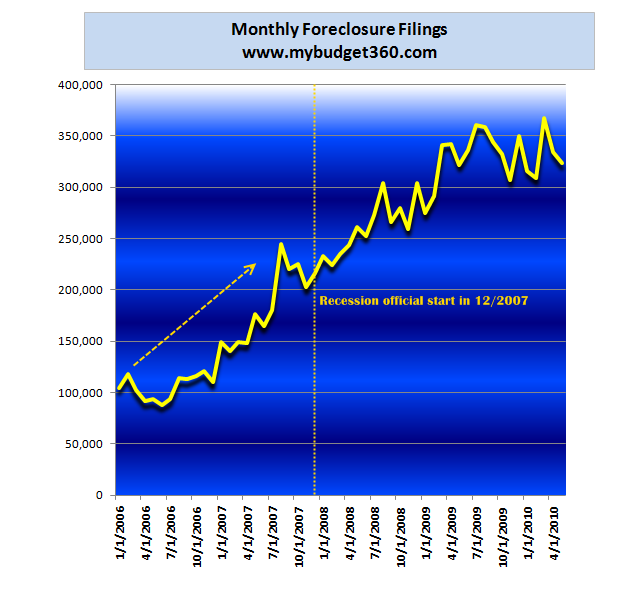
The above rate will put us at 4 million foreclosure filings for 2010. Interestingly enough, we can see that the amount of foreclosures started tracking up in early 2006. Even though the actual recession did not start until December of 2007 we have nearly a 22 to 24 month gap between rising foreclosure filings and the actual official start of the recession. Keep in mind that during 2006 the housing bubble masked some of these problems. Part of this comes from the inflated prices and a market that still had buyers willing to pay higher prices with easy financing. Even if a homeowner was behind by 3 payments they were then able to sell it into the momentum of the market. As prices collapsed, the underlying problems were fully exposed.
Now much of the blame has been put on toxic and trashy mortgage. No doubt this is the nucleus of the problem and much of this was spurred on by Wall Street and their insatiable appetite for mortgages to put into their exotic mortgage backed securities. However if we look at HAMP data carefully we will realize that beyond toxic loans, the housing market was running on pure fumes and speculation. In fact, those going into HAMP modifications have a unique ability to tell the truth as to why they are going into housing distress. This is a look in between performing loans and non-performing loans:
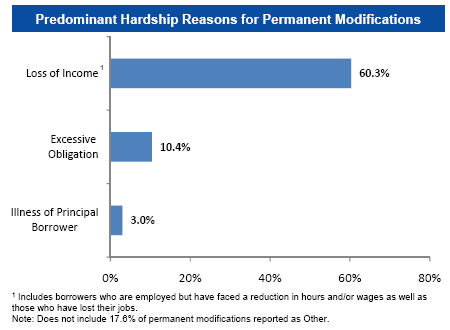
This is a very telling chart. The largest reason for hardship is loss of income. Let us be clear here:
“The biggest reason people are entering into HAMP loan modifications is loss of income.â€
This is something that the banking industry doesn’t want to reveal because it would strike at the core of their argument that loans simply need to be reworked to make things better. In reality, we need something much more substantial and this will only come from having a healthier economy. Anyone that lives as a working class or middle class American realizes that the economy is anything but healthy. The reason foreclosures are near record levels is because the real economy is still struggling with pervasive problems. If we look at the HAMP data we realize that many loans don’t qualify because income levels do not work even with this generous program:
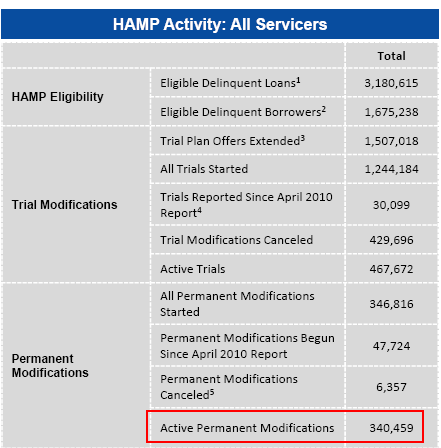
Over 3 million delinquent loans are eligible for HAMP. Of the actual borrowers, there were 1.5 million trial offers extended. From that, we see that only 340,000 permanent modifications have taken place (this doesn’t reflect the current new foreclosures coming down the pipeline). And many of these will re-default because as we have seen the number one reason for distress is loss of income. How can someone pay a mortgage if they have no job? It isn’t like HAMP strikes at lowering principal:
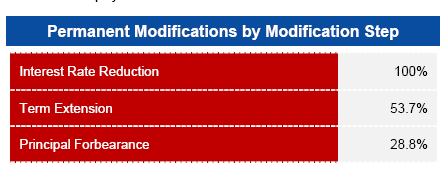
You’ll notice that all the help is guided at protecting the banks. Term extensions and principal forbearance are merely extending the misery for many that can’t afford their homes. Many would be better off renting. Yet banks want to extract every single penny for their years of horrific mismanagement and their primary cause for the housing bubble. A principal reduction would force banks to eat the loss and actually have to recognize real losses on their balance sheet. At the moment, they are happy pretending things are good so they can extract additional money from taxpayers and make billions gambling on Wall Street.
Contrary to things getting better, the call center volume for HAMP is still as active as ever signifying that problems are still at peak levels:
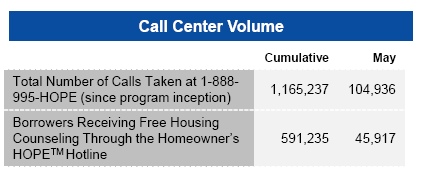
This data is probably the closest we are going to get to having a reason for current housing distress. Clearly toxic loans are involved here too yet the major theme of this all is that the real economy in a reflection through wages is the absolute major reason for current housing problems. After all, since the collapse of the mortgage market 95+ percent of all loans are now “safe†government backed loans. Yet problems are still here. So doesn’t it seem unwise and downright illogical to try to get more people to buy if clearly wages and jobs don’t support this? This is why it is absolute nonsense that tax credits and trillions of dollars to the banks were given under the pretense of helping people to buy homes and keep lending activity going. I’m sure most average Americans now realize the shell game that is occurring. The fact that new home sales collapsed last month to a low not even on record keeping data going back to 1963 is not a shock. It merely suggests that without government tax credits and artificial subsidies the housing market is running on fumes. This isn’t different from 2005 and 2006 when lenders got more aggressive with going no-doc, no-income, no-nothing, and gave loans to anyone and everyone just to keep the party going. The market was telling us something else.
Yet here we are in 2010 repeating similar mistakes. Yet my sense is the overall population isn’t behind all this. They would like to put their overall feelings about the housing market into words but cannot. In some markets, home prices remain inflated because of these programs subsidizing the rich while those in poorer to middle class communities subsidize the current wealth transfer. It is pretty clear that without a strong economy housing is an afterthought. Spending more and more money with banks is a futile effort and it is no shock that after $12 trillion in bailouts and backstops that there is very little to show for everyone else.
 If you enjoyed this post click here to subscribe to a complete feed and stay up to date with today’s challenging market!
 Follow us on Twitter!
If you enjoyed this post click here to subscribe to a complete feed and stay up to date with today’s challenging market!
3 Comments on this post
Trackbacks
-
RealisticOptimist said:
Wage loss is half of the problem, and the other half is that the houses were bought at a price that just isn’t affordable. If we didn’t have the housing bubble and just had 9.7% unemployment, these foreclosure rates wouldn’t be nearly as high because the monthly payments would probably be half of what they are. However, arguing that point is a bit moot, since the housing bubble crash is most of the reason for the high unemployment. This whole thing is a big ugly mess.
June 25th, 2010 at 7:24 am -
Craig Meinke said:
Something to ponder on;
If the banks are allowed to suspend general accounting rules and not mark their assets to market, (mark to market), then why are the home owners being told that they cannot refinance their mortgage because they are upside down on the loan. The banks and the public are operating on two completely different set of rules. The banks are currently not recognizing any losses on the mortgages they are holding because it would most likely mean they would be a candidate for an FDIC insolvency closure but yet the average homeowner cannot refinance a mortgage because they are subject to using the real appraised value of the home and as a result of that are underwater on their mortgage. If anyone cannot see the hipocracy in this then you are living on another planet. Most people do not want a bail out from the goverment. They would just like to take advantage of the lower interest rates being offered but unfortunately cannot because our goverment does not want this crisis to be resolved quite yet. Because of the liabilities that social security not present because of a corrupt political system that has spent your retirement we are now subject to the only remaining alternative, debase our currency. The politicians therefore will never have to face the public and tell them that their SS checks will have to be cut in half because of decades of mismanagement. Instead, the spending power of the check you recieve will buy half as much as it once did and the retired middle class of this country will end up living a retirement similar to those in third world countries. America….please wake up from your slumber and change the direction this country is headed. The only person to blame is the one staring back at you in the mirror.July 5th, 2010 at 3:39 pm -
scott ryan said:
This problem is easily fixed. read on
THIS IS IN AU $, IT = OUT TO BE THE SAME ANYWAY.
The first thing the government will do is start a new $22,000 first home, but, used home grant.The government will buy $50 billion dollars of solar panels, in big bulk, to get a good deal. The government will then include a electric hot water system, that they will buy in mass bulk to save mass money. The government will also buy a electric stoves in mass bulk, making it, buy 1 million, get 50,000 for free. so it works out to cost them $700 instead of $1,000. same goes for a hot water system, they buy 1 million worth of hot water system, and pay $1,000 dollars, instead of $1,400, or save even more.
The government will get a mass deal on $50-$200 billion dollars worth of solar panels.
The government will make that, the people get $20,000 worth of solar panels, that is in big bulk too, it should = $30,000 worth.
They will also get a $1,000 electric hot water system & a $1,000 stove / oven, it’s all gotten in big bulk too. Save mass money & start lots of jobs.
Now mass people can buy houses. If people get free solar panels, they don’t pay electricity bills. If they get free electric stoves and hot water systems, they don’t get gas bills. so people will save on average $3,600 a year, or more. so people will save about $300 a month.
If people save $300 a month, people on minimum wages could by a home / get a home loan easy. People that get better then minimum wages, could get a home loan easy.
If people save $300 a month, they could pay off a houses easy. Each month there morgage payments / home loan payments, will be $890 a month. if they save that money from no gas bills or power bills, they can take $300 dollars a month, off there loan repayments.
If people save that $300 a month, there repayments would be $590 a month instead of $890.
Now People pay more then that a month on renting a house. even if it cost them now $990 a month for loan repayments, it will cost them $690, still way cheaper then renting, and would hit the banks amount of money you need to get a loan and afford to pay it off.
Houses are so cheap now, & they will get to take a extra $300 off there home loan repayments every month, so mass people will buy houses now.
If the government does this, mass houses will be sold, then they will start a, brand new first home solar grant.
The government would first / at same time, spend
$200 billion $ on buying houses, so they can control the housing market.The government will buy 200 billion $ worth of houses all over America, in key areas. The government would then rent 90% of them houses out, fixing a renting crises at the same time.
Once
The government does that, they control the houses market / interest rates, by relicing houses onto the market, if the prices of houses go way up.The government can control the housing market by relicing houses onto the market, by flooding houses
to lower the price.The government can also rise the prices of houses, by buying up all the houses after they buy lots of houses, & start mass houses being sold.
As long as they buy them all of them houses cheap now, they will not have to buy many latter to control the housing market.
So many people will buy houses now, along with the government.
Right Now if people go to buy a house, there is not even 2 people bidding on a house, that creates no compaction no bidding, no market. that’s why the housing market is no more. If the government starts a used first time home buyers grant, and the government spend $200 billion $ on buying houses, the house prices will go up a big % over 2 years. once they do that, there will not be many houses on the market after that, and there will be 20 people bidding on 1 of the limited houses for sale in 2 – 5 years, & that creates compaction, that creates houses going up in prices.
If peoples houses go up, many people will sell there houses and buy a different house. right now there houses are worth nothing, so they can not move or buy a different house, its just the way it goes / works. if your house cost you with a loan $600,000, you can not sell it for $200,000, nor would you even if you paid $600,000 cash with your own money / no home loan. once the prices of houses goes up, many people will sell there houses and move, and buy a different house, as them people sell there house, other people buy there house and sells there’s as well, showing the housing market mass houses sales, but really, they are just swapping houses, but the real estates will show mass houses being sold.
So first the government will start a used first home grant, that will give people free solar panels & electric stoves & hot water systems. That will take away there power bills & gas bills giving them a extra $300 plus to pay off the home loans.
The government will also buy $200 billion $ worth of houses, to control the housing market, by relicing house onto the market if they get to dear, that will lower house prices if they flood houses onto the market and then do this to control it properly.
In 1 to 2 years time, the government will start a brand new first home solar grant, that will start more mass houses being built.
To control the housing / market, the government will also need more houses been built, to free up demand, or there will not be houses for sale, and houses prices will be way way to high.
The government can control the housing market, as long as after all them used / 2 million houses become limited, more houses are built to help them.
If the government does not start a first home solar grant, they will lose control or the housing market / house prices. That because all the old / used houses will be sold, there for there is no houses for sale, or only had fulls seeing, will 100 people bidding on 1 house.
If that was to happen, the government could only relic house for a amount of time, unto they are all sold, then they would lose control of the house prises / interest rates. Thai is why they will mix it up, to stop that from happening.
So the government will spend $200 billion dollars on buying houses, that will only allow them to relic houses up to a point / they will run out in 4 years time, because there is to much demand / everyone has got a house, buying up all the houses on the market now. so the government will mix it up. The first year it will be a, first home used home buyers grants, used house grant, & at the same time the government will mop up $200 billion $ worth of houses. then after 1 year, it will be brand new first home grant, that 0r 60% used houses & 40% new houses, to get people buying up used houses to first, to rise the house prises a bit, then the other 40% will be new houses being built, to make shore the government will not lose control the housing prices, buy relicing some houses to lower the prices a bit, if they have to lower the price in a bad time.
So you first what to get most of the houses flooded on the market now sold. that will rise the house prices a bit.
After that happens, you want new houses to be built to start mass jobs and too stabilise your control in the housing market.
The government does not want to sell all there houses to lose control of interest rates & the housing market.
If the government buys the $200 billion dollars worth of houses & starts a new used first home buyers grant, they will get 85% of them houses off the market rising the prises of houses a bit, then they start a brand new first home grant to stop people buying up all the houses, sending the prices up 400%, because all the house are sold, & there is non left. So thy control it buy stoping a used first home grant once 85% of used houses are sold, & starting a first home solar grant, to have more houses on the market, letting them control the prices, by relicing houses to lower the prices, and buy making people buy brand new houses after 90% of the old houses are sold, that would stop all of the houses being sold, that will stop rising the prices of houses so so high, & interest rates.
So if you start a new house grants, people will only buy a new house, stooping every old / houses being sold, that stops sending the prices way to high, that you want to control. new houses are being built, so used houses are not all being sold now.
If the government just keeps just doing used house first home solar grants, all the houses would be sold, and they would have to sell off all there houses very fast, losing control of the market.’ if they let mass / 92% of used houses get sold, then start brand new home grants, they will not need to sell of there houses. the grant is now for new houses only, not used houses, so they will leave 8% of houses free on the market. that would send prices up a bit, but there is still 8% of houses on the market, and they can then relic a extra 7% to bring the houses back down to what they want.
The GOVERMENT only let people build houses with the grant, letting them control the housing market forever just about. if used house start to drop off leaving say, 19% on the market, they just change the first used home grant, too brand new house solar grant. this is the way you fix the housing market and control the prices. it will work and start a mass houses being sold, then latter mass new houses being built, that start mass building jobs. the point is to control it, if everyone buys a house in 7 years, the housing market will full. control it and house prices. this is the only way America and all allied country’s can get out of this housing mess, but at the same time, it will start a housing boom, why going green as well, why starting mass jobs that would more then kick start Americas / the west’s economy’s. it would see a surge in the economy / big growth. we must takeaway the power and gas bills. that will allow people to pay off used houses then brand new houses on minimum wages, and people that get more then that, can also build new houses with ease.
The point is.
1, they start a used home solar grate to get mass houses sold, & take away gas & power bills to allow mass people afford houses. they also buy mass houses to control the prices.
2, they then start a brand new home solar grants, when to many houses are sold, to stop a housing market with no houses / house are 2 million dollars each / to dear, and so the government can control the market.
3,once they force people to buy a new houses, the demand will drop off & all used houses will not be sold, there for the government just relices some of there houses, dropping the prices.
4. They control it buy relicing houses, & by start a new houses grant that everyone will have to do, to afford the home loan. That lets them own 25% of the houses left on the market for sale, because everyone is now building new houses because they have to / save $300 a month because that’s the grant now.
5. All the government has to do is, dump 10% of there houses extra onto the market, know one will buy them because the first home solar grant, is on new houses. there for the prices will drop along with interest rates.
6. They can make it what ever they want the price to be, as well as interest rates. No one can afford a houses with out the grant just about, & any one selling there houses once the price goes up, will be buying the other person house that did the same thing.
First home grant, if you own a house and sell it, you can not get the grant, first home buyer grant.In the end they will do second brand new home solar grants, but that would not be for a very long time.
creating mass jobs
The government also need to cut taxes on each company. just $750 for a small company, so he can hire 1 more worker for free. bigger company’s can hire 20 more people for free. the key is to forcing de-faco partners on the doll / government payments, to get a job first. in Australia they would get about AU$1,350 every 2 weeks. if the man got a job at, well say he earns AU$750 A week, they would only get $80 child / kid government payment that everyone gets. he would pull in $1,580 every 2 weeks. the government would save $1,220 a fortnight. if she gets a job as well, they would be way better off, but because he earns that much money, there pay would be cut by 96%. the key is to target the jobs to people that get the most money on government payments. first at least 1 person in a de-facto relationship must get a job. but really both of them a job first. if the government got them both a job, not only would they save $1,300 a fortnight, they would also get taxes from there wages / work pay. the government would start a new daycare rebate of 7% of the cost at the end of the year. they get that money 2 weeks before Christmas. that will also see big spending’s at Christmas time, flexing the economy.
Also force everyone to put AU$3-5 extra into there supper fund. that money can only be invested in there country too. times that buy 220 million people, times 52 / a year. that would start mass mass jobs as well.ÂOctober 8th, 2010 at 3:49 am