Where the Jobs Are and Baby Boomers: Healthcare Growth and the Feeding of a Graying Population. Is a Post-Baby Boomer Society good for our Economic Competitiveness?
- 3 Comment
Seventy-six million American babies were born between 1946 and 1960 and we call this group the baby boomer group. Many trends can be seen coming with this group. Major toy sellers including Mattel came about this time. In fact, much of their success included this right timing since Mattel was founded in 1945, just in time for all those new babies. But all those babies are now starting to get older in age. It is no stunner that healthcare is now a booming field. In fact, I would argue that even if things stabilize in the banking sector and housing market there will be a glut of homes because many boomers will be downsizing. It really is no coincidence that as our society ages, that healthcare is now being brought to center stage.
First, let us examine the growth in the healthcare field over the last decade:
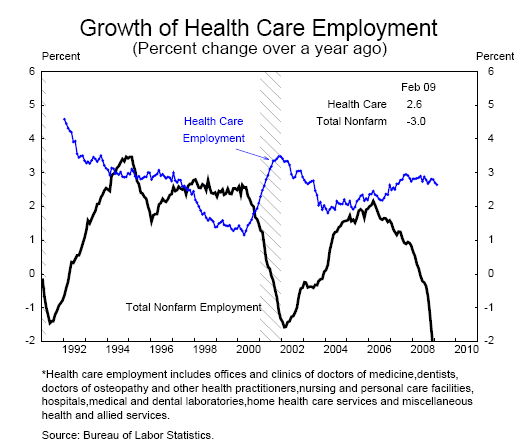
As our economy is shedding jobs in multiple sectors, healthcare has remained rather stable. This of course has to do with the fact that many baby boomers are now retiring and requiring more healthcare services. If you really doubt this, all you need to do is watch the nightly primetime news and see the advertisements. Every other ad is about some new pharmaceutical and how it will make your life perfect. It is a fascinating study in sociological trends our country will be facing. In addition, it would logically follow that healthcare is now taking up a larger percentage of all employment in our country:
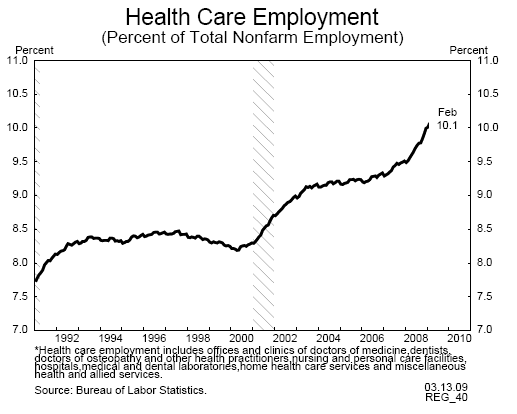
Only recently has healthcare employment crossed into the double-digit realm. Of non-farm employment, healthcare now makes up 1 out of 10 jobs. And you can see that it has been growing through both the earlier 2001 recession and the current recession. Although the current deep recession has put the breaks on employment including healthcare to a lesser degree.
Another reason this is such an important issue even from an economic standpoint is that more and more money is being spent on healthcare. And this is happening at a time when more and more Americans are losing their jobs and losing healthcare coverage. Recent estimates find that 48 million Americans are without healthcare. Let us take a look at expenditures in the healthcare field:
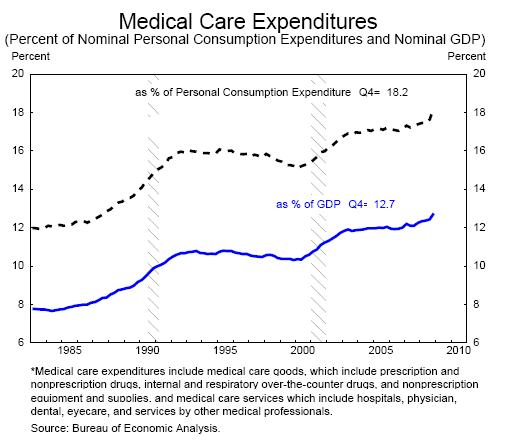
Medical care expenditures now make up 12.7 percent of our GDP. That is an astounding number.  This includes everything from prescription drugs to payroll for medical billing and coding staffs.  And this number will only continue to grow because we are only at the frontend of the baby boomer retirement tsunami. This couldn’t be happening at a more challenging time for our economy. In fact, this issue has been neglected through the 1980s, 1990s, and 2000s. We now have no choice to deal with this crisis but we are facing a global recession that is shifting priorities like a ship in a tempest. This has all occurred even though healthcare costs have seen some stabilization:
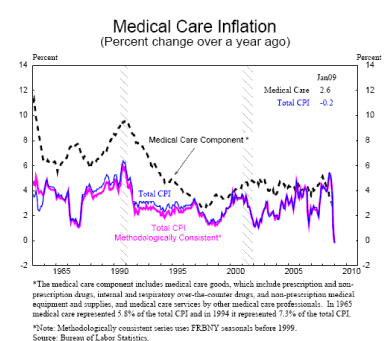
It will be a challenge confronting our society and will also force us to examine what we value and given a climate of limited resources, will force us to prioritize where we want to spend our money. We cannot do everything that we want. This new austerity is making us realize that we cannot pursue everything even though there are many worthy proposals on the table. Let us examine the demographics of the Untied States:
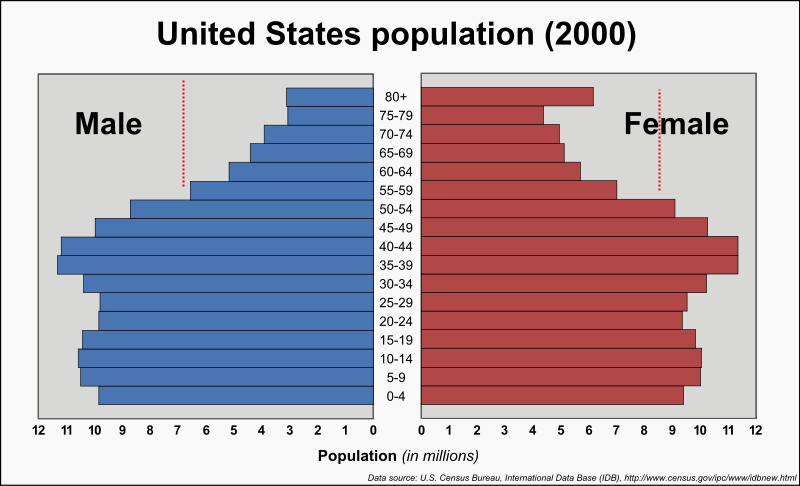
What you are going to see, is the top half of the chart increase as more and more baby boomers retire and age. In addition, the birth rate in the United States has also been falling so what you have is a reverse pyramid structure starting to take place. That is, more and more younger workers are going to support more and more older workers. To highlight this point, let us take a look at a chart:
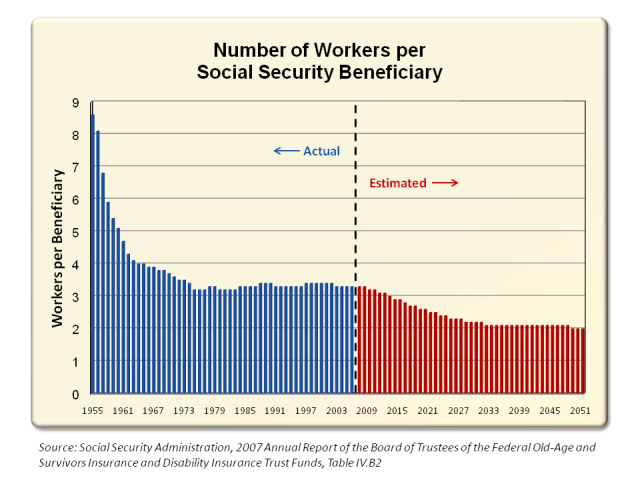
*Source:Â Perot Charts
What many older workers are already realizing in this climate is that retirement is not assured. Social Security is not a lot of money. I think some tend to think of entitlement programs as golden parachutes but they are anything but. Let us look at Social Security for example:
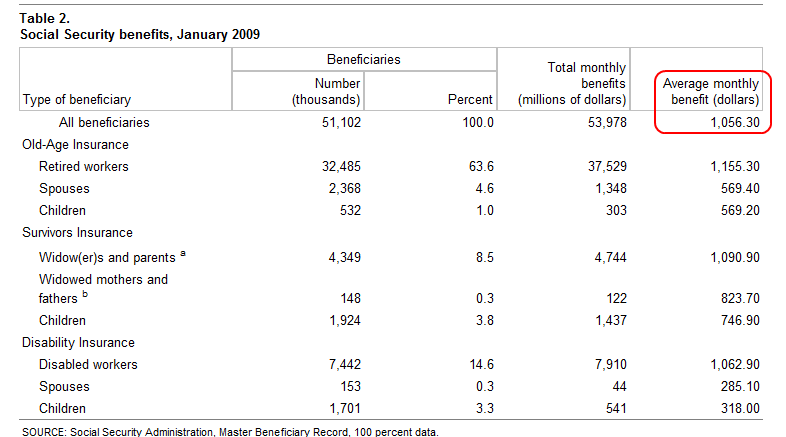
The average monthly Social Security benefit for those receiving benefits is $1,056. You are not going to be rich with that and you certainly won’t be able to afford expensive medical treatment with that amount. So the strain starts to occur because of the raw number of people receiving benefits. In January alone $53 billion in benefits were given out to 51 million people. And with an aging population, you can rest assured more people are going to depend on Social Security only to get by.
And even though in the midst of the this economic crisis, the U.S. Treasury and Federal Reserve also need to confront the rapidly changing needs of our economy and not simply focus on banking or housing. Healthcare is something that will be a major issue in the upcoming decade. Unlike banking or housing, this is a booming field with many opportunities for successes and failures. And what is even more daunting is Medicaid and Medicare spending:
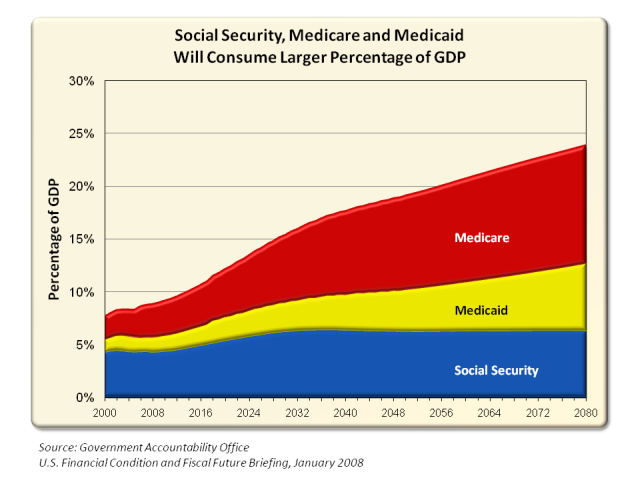
All these charts are confirming the same thing. Healthcare is becoming a larger part of our economy and eating up more resources. Yet will this make us competitive in other areas if this starts crowding out capital in other industries? We already realize that the global economy is not sympathetic to mistakes.  These are major issues that we will be facing and having a deep recession does not mitigate the responsibility of dealing with this. There will be a major debate and dialogue regarding healthcare and our hand is now forced to deal with it.
If you enjoyed this post click here to subscribe to a complete feed and stay up to date with today’s challenging market! If you enjoyed this post click here to subscribe to a complete feed and stay up to date with today’s challenging market!
3 Comments on this post
Trackbacks
-
greg said:
But so what’s the problem, exactly, with healthcare taking up more of the GDP? Compared to spending it on… what? Our society is willing to spend a larger percentage of GDP than this on the military and defense, supposedly because we won’t accept a terrorist or foreign nation doing anything that might jeopardize the lives of a few thousand or even a few million Americans… yet healthcare is about preserving the lives, and the economic productivity, of over 300 million of us. Compared to the bang we get for our buck from the Pentagon, that seems like a really good deal! And what else do we spend on? Housing, food, transportation, which we don’t consider it to be a problem if they cost something more each year, fine… but then after that it’s toys, gadgets, crap, non-nutritional food, luxuries…. we don’t consider that a waste? On any reasonable list of priorities, preserving our lives and health should be near the top, way above $50,000 vehicles and McMansions and unnecessary weapons systems.
March 13th, 2009 at 12:45 pm -
marc said:
People born in 1960 should not be grouped in with boomers. 1959 is really the last of the boomers. Why? Because if you were born in ’59 and joined the military when you were 18, you were eligible for GI Bill (free college education).
If you are born in 60, joined the military at 18 (1978), then you got nothing because this program was dropped in 1977. I mention this because I believe the people born in 1960 will again get shafted when SS time come around.
March 20th, 2009 at 5:57 am -
gasoline cards said:
Yes, actually the elderly population is increasing globally. Japan apparently has a ridiculously odd population and an extremely low birthrate. Rising interest in the health care field has been rising along with rising demands. Its unfortunate that a mixture of terrible economy status and a rising elderly population have combined, it makes it tough iron the entire country.
-Randy
June 14th, 2009 at 9:26 pm