The catastrophe of our economy for the young American worker. Average college debt higher than typical new automobile cost, annihilation of pensions, and younger Americans moving back home because of financial necessity.
- 14 Comment
The economy for young Americans might as well be in a parallel universe to the stock market run since early 2009. Talks of recovery must fall on confused ears as many young college graduates compete for fewer jobs with higher amounts of student debt. In the last decade college graduates have encountered the highest tuition increases ever while getting a lower return on their investment once they enter into the workforce. The economy is still a mess if we dig into the data and look outside of the stock market gains. Many of the S&P 500 companies added jobs globally but outsourced many domestic jobs to foreign markets to save money. So profits increase but how does this help the domestic job market? It doesn’t and that is why this recovery is one of low wage capitalism and banking handouts. For the millions of young Americans that are entering the workforce with tens of thousands of dollars in student debt, what can they expect from the current economic structure?
The old and the new
The cost of living has soared across many sectors with food, healthcare, college tuition, and energy all outpacing the growth in the typical paycheck. For these reasons including fewer jobs, young Americans are facing harder times when it comes to saving money:
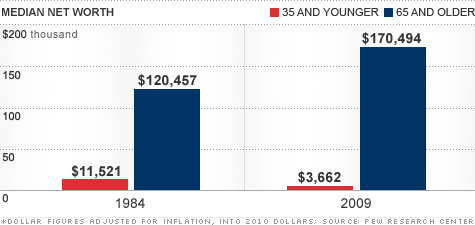
Source:Â CNN Money
 “Ultimately we are pumping out hundreds of thousands of graduates each year that are starting with a negative net worth.â€
Contrary to what is being spouted on the media, the employment market is still very weak:
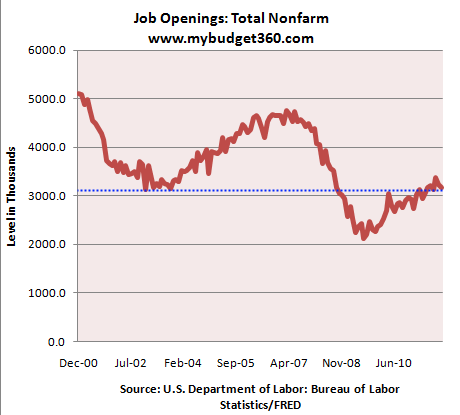
Source:Â Census
You have nearly two million job openings less than we did before the recession gained full steam. Yet our population is expanding and recent graduates are entering the workforce in higher numbers. The recent job growth is positive but the underlying data shows that many of the jobs are coming from low wage fields. Many companies, like those in the S&P 500, are exporting jobs to other countries where they can push for lower labor costs. The question remains, how does this benefit domestic workers? To the point, this is more momentum when it comes to squeezing out the middle class.
Diluting education
Part of the reason recent college graduates have also confronted lower wages is the dilution in higher education:

Source:Â Senator Harkin
For-profit institutions that largely run as full-time systems to devour government financial aid, increased enrollments by a stunning amount over the last decade. A large number of students entered the workforce with large debt and degrees that meant little to current employers. This is only one reason we have seen a dilution to the earning potential of college graduates:
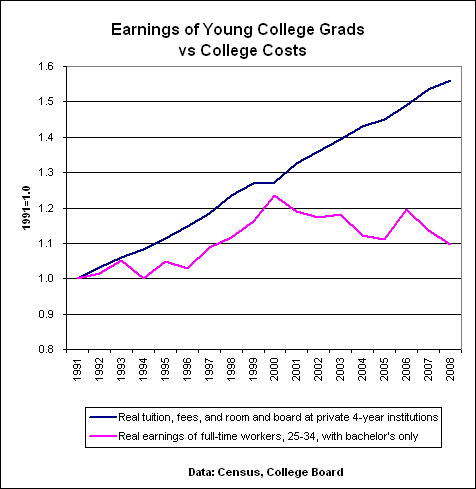
Source:Â BusinessWeek
Now think of someone coming out with $50,000 in debt and only being able to land a part-time job at Wal-Mart making $9 or $10 an hour. What will they do when those monthly student loan payments start coming in? With college debt going over $1 trillion this year this doesn’t seem like a trend that is reversing anytime soon. Tuition has gone up across all higher-education systems:
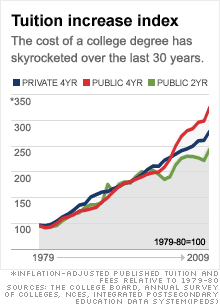
Source:Â CNN Money
This is not a trend that is favorable to younger Americans. And this is why millions have moved back home during this recession:
“(Salon) Is this current generation a bunch of lazy loafers? Your research doesn’t seem to indicate this.Â
No. They are a generation that has been caught by a series of unfortunate, overlapping trends that put them at a disadvantage for becoming independent the way their parents did. They’re entering a very unfriendly labor market that is particularly punishing to young workers. With the housing implosion in the United States, they’re still entering a housing system in which owner-occupied housing is very expensive. So, they have lower wages, if they have wages at all; they have high housing cost; and, in the advanced countries, there are ever more demanding credential races to qualify for professional employment. If they’re aspiring to be middle- or upper-middle class, the length of time it takes to pile up the education you need to qualify for the jobs to make that possible is getting longer and longer and more and more expensive. When you put all those things together, it’s not all that surprising that the accordion family has developed the way it has. It’s just a bunch of really bad circumstances that have coincided and affected this generation in ways that have not been the case before.â€
I think the above is very important to consider since there seems to be a perception that many of these younger Americans are lazier than older generations. In other words they are not pulling hard enough on those bootstraps. I think there is a large combination of forces coming together here. For example, in the early 1980s you had 60 percent of workers with some sort of pension. Today that figure is in the low 20 percent range. New workers are thrown into 401k style investment plans and are left dealing with a stock market that is built on a riskier foundation than betting at the horse track. With high frequency traders and investment bankers that make billions of dollars on short-term bets that actually destabilize the economy, many younger workers are simply trying to get by let alone coming up with an investment plan.
Keep in mind that this is a crisis of generations. Many retired Americans depend on younger workers paying into the system to keep it going. So there is a two-way road here. If we do not find common ground you are going to have more protests, frustration, and struggles between young and old. This is a challenging economy for the young American worker.
 If you enjoyed this post click here to subscribe to a complete feed and stay up to date with today’s challenging market!
If you enjoyed this post click here to subscribe to a complete feed and stay up to date with today’s challenging market!
14 Comments on this post
Trackbacks
-
Rachelle said:
I don’t believe that any digging is required to see what is going on for middle and lower class Americans. This economic situation is even more of a slap in the face when politicians cannot/refuse to relate to their constituents and media outlets refuse to discuss reality without any spin or hidden agendas. I can remember going to a community college about a decade ago and the price was just 60% of what is now that I’ve been gathering info for my college aged nephew who is considering going into the military for a “guaranteed job”. Over my DEAD body I say. His mother lives check to check as a well educated corrections officer because that was the only job she could find and she has been unable to find a better job for a couple years now. I believe that at the very least it will take 5 years or so before there is truly a change that middle and lower class Americans will see and feel.
January 21st, 2012 at 10:02 am -
david turco said:
These figures are of course averaged across America, so it really doesn’t show how much worse the situation is in the north east. The college debt in New England 30 years ago was more than the cost of a car. Now it’s closer to the cost of a house, in other words one graduates with a mortgage debt but no house to live in, just a worthless degree. And that’s what is coming to the rest of America in the next10 years or so, it’s only going to get worse. Economically, everything happens in New England first then the rest of the country catches up. NE was founded first, 1620, we had the first college, Harvard, 1636, started the industrial revolution in the US, 1854, and started de-industrial revolution ~1925 (when the mills first started to move south). Cost of college was highest here first and it only goes up. Wake up America.
January 21st, 2012 at 11:29 am -
stephen said:
Its a major reason why the states do not get it. Minimum wages must be indexed to inflation to keep predatory capitalism under control. Higher min. wages allow for the value of their labor to be captured even in the middle class. When the 1968 worker wages indexed to inflation is still higher than the few states that have proposed raising minimum wages to just over $10 an hour we are in serious trouble. Downward wage pressure for the last forty years results in the dependency of the middle and lower class on the plutonomy. The plutocrats are directly benefitting from the taxes being paid being used not for the social commons but for returning those funds to the corporations they run in the form of tax refunds and subsidies. It is really not working very well. Meanwhile the middle and lower class fixed costs continue to climb. Food is up, clothing is up even with after christmas discounts, shelter is still being built to waste time (long commute distance locations) or fuel (still being built to old energy standards making each family a hostage to energy price shocks.) How to solve this will require both republicans and democrats to realize that the economy needs to be internalized to produce products for a homeland. We need a sustainable economy honoring labor and family because unsustainable predatory capitalism will continue to crash taking all hands on the ship.
January 21st, 2012 at 12:56 pm -
gmathol said:
Let’s create the Dumb Party.
First heal the CEO’s, make the rich richer by giving them all your money and keep them tax free, don’t be jealous if you have nothing to eat and have to sleep in the open.
More wars! Zero taxes to the rich! Serfdom and Slavery are the obligation of all Christians!
Heal to the CEO’s!
January 21st, 2012 at 10:57 pm -
surfaddict said:
stephen is right! Min wage should be a million dollars an hour, that way we’d have 500million people fighting for the 100,000 jobs left over. Pull your head-out!!
January 23rd, 2012 at 9:24 am -
Rick said:
I am sorry but I have little pity for kids who think going 50k into debt for a useless liberal arts degree is a good idea. Nobody forced them to take out that loan. There were a lot of kids in my class (1980) who could not afford to go to college and have done just fine. There were some who did go and are making far less in their adult life. Some had wealthy or upper middle class parents who could afford to pay for it and others worked two and three jobs to get through but I can promise you, not a single one of them took out a crazy loan amount that anyone with enough math courses to even get into college could see was a horrible investment and one that would leave them in debt for 30 years. Welcome to the real world kiddo. Work hard and you will probably get somewhere but that degree you thought was a promise for a starting wage of what your parents retired at is a pipe dream. Reality is going to hit most of these kids like a brick in the face.
January 23rd, 2012 at 10:29 am -
lynn said:
Minimum wage jobs were never intended to pay a person enough to live on, but rather, they were jobs that allowed a worker to enter the work force at an entry level position, gain skills and working knowledge to move up to high paying jobs.
As an owner of a small business, I would love to hire an ambitious, just starting out, young person, but at the cost of minimum wage plus social security, work comp, etc. we just can’t afford it. Instead, two of us are doing the work of three people. So, the next time somebody says that the problem is minimum wage, you might want to think about what increasing minimum wage will really do to the job market.
January 23rd, 2012 at 2:08 pm -
dude where's the ... said:
as the world gets more efficient, it needs less worker to do more work. do some research. now, it’s really tough to make money and it’s tough for folk who even tries..just imagine how it’s like for the rest of the “zombie grads”..good luck. if you never learn to “make a living” while you were young, you ain’t gonna learn it after you get your toilet paper degree.
January 23rd, 2012 at 4:54 pm -
dude where's the ... said:
@stephen, funny, if you “index” min wages to inflation, it creates a never ending cycle of prices going up..you doofis..and min wages are exactly that, it’s MINIMUM WAGE, NOT LIVING WAGES..gee..get a clue, a min wage job was never meant for you to live on, it was meant as a wage that allows green or newly hires to learn on the job. you ever took econ? in order for a biz to raise wages, it has to be more profitable than before, if you MAKE them raise the wages, they will either NOT hire and cut staff, or raise prices for their products. in Samoa, they use to have a thriving fishing and canning biz, but they closed it, not because of no fishing, but because they raised the min wages, now those jobs are gone!..company figured out they couldn’t make $, and left. if you ever ran a biz, you’d understand..and if you don’t like your wages, make your own business and be a boss instead of a crybaby worker, and most workers are crybabies thinking they should make more than they are getting but are too chicken to do their own biz..crybabies.
January 23rd, 2012 at 5:02 pm -
adam said:
The Fed has many students leveraged. Why do the armed services offer total repayment on student debts? Expect many more wars and many more volunteers from this demography to pay their education through signing up.
January 24th, 2012 at 9:06 am -
Mary said:
Not everybody is cut out for college, and it is true that a lot of degrees, by the time they are earned, may end up not being worth very much. Perhaps the ambitious young person would be well served to decide what the ultimate goal is in gaining a college degree before pursuing one. Does that person want to land a job, in this country, and keep it through good economic times and bad? It’s hard to outsource the services of an emergency medical technician, a plumber, or a fire-suppression system installer/inspector. Maybe a college degree isn’t required for any of those occupations. Does that person want to be mobile, such that if the job requirements change so much that it becomes necessary to go to work, at least for a time, in another country? A second language is required, maybe a third language, and one would have to be conversant in them in order to get comfortable in the foreign country. So, along with the college degree, picking up a second or third language should receive added priority and not be treated as an annoying “elective” just to be gotten through for the credit. Could people do better at equipping their children to compete in what is referred to as a “global economy”? Maybe, but a serious shift of mindset is needed. To rely on the school systems to prepare the child to be self-supporting is a serious mistake. Ideally a child should emerge from the school system with basic knowledge and skills required to hold down a productive job, and in my opinion, if the training in a second language were absent or inadequate in the schools, that child should graduate eighth grade partially homeschooled and conversant in not only American English, but also Spanish, or Mandarin, or even Brazilian Portuguese
March 13th, 2013 at 4:14 am -
Mark said:
Here’s is the problem. We can’t think for ourselves anymore. Kids go to college thinking that when they get out someone will hire them. And then they get to work for the man. While the man gets rich the kids think there living the dream. They have a low paying job
Barely making it getting up everyday thinking this is living. And then one day they wake up and realize they will NEVER make it working for the man. The only way to make it in this world is to work for yourself. It only takes one good idea That’s what I did I started multiple businesss with little or no money. Then sold them for a profit And the kicker is I never went to college. I look around everyday and see people who could be so much more in life if they only risked more and took a chance on themselves. As Americans we think we need to have the big house multiple cars and all the toys. The trick in life,is to live simply. The Sherpas in,the Himalayas have a saying. That all you ever need you have already. Somewhere along the way Americans got there prioirties out of wack.August 18th, 2013 at 9:54 am -
Roger said:
“Minimum wage jobs were never intended to pay a person enough to live on, but rather, they were jobs that allowed a worker to enter the work force at an entry level position, gain skills and working knowledge to move up to high paying jobs.”
Not enough to live on? Tough to gain skills when you’re dead, isn’t it? Or is the person supposed to pick through the dumpster on their lunch break?
March 11th, 2014 at 7:22 pm -
Dixie and me said:
To-days entire economic problems officially commenced in 1982, when the reigning president of the time eliminated the laws that prohibited corporate off-shoring and importation of foreign specialists to subvert the stateside wage base. These are the same exact causes determined by millions of dollars spent in government research, to have led to the great depression. Following WW2, the law was passed to forbid this nefarious exploitation of national boarders….I know what I speak of because I have lived through this dismantling of our economic checks and balances.
Well, if we all shall dare to recall…when the corporations commenced to offshore, the ones remaining commenced to cry, saying aloud that they could not compete with offshore wages. Our government of the time began to subsidize those corporations, so that they could keep paying out the necessary wages allowing workers to access the US cost of living standard, and keep those companies from busting wages or simply just closing down.
At the same time, the universities commenced to cry, saying that the off-shoring of jobs would cause people to simply stop signing up for university, and the university system would simply just collapse. Our government at the time simply informed the remaining corporations, that when individuals applied for employment opportunities, to not tell them that no opportunities exist for employment, but to instead inform them that they must possess at least a four year university degree before the possibility for employment opportunity was even to be discussed with the applicants; thus the chance for a real job never even existed in the first place. This fact effectively explains why people with Doctorate degrees were and still are working at Walmart stocking shelves and bagging groceries for part time minimum wages and no benefits whatsoever.
In short America, YOU HAVE/still are BEEN LIED TOO!!! WAKE UP!!! YOU HAVE NEARLY LOST OUT TO THE FASCIST PIGS RUNNING YOUR PRECIOUS NATION, WHO ARE ONLY SELLING YOU OUT TO THE HIGHEST BIDDERS AND DOOMING YOU INTO A FUTURE EXTORTIONIST PERSECUTION!!! TAKE IT TO THE STREETS TODAY!!!! WHAT YOU NEED IS A SHINING ANOINTED WHITE KNIGHT TO RESTORE YOUR PURLOINED RESPECT AND PAST GOLDEN GLORY…. Righteousness can only be redeemed by the purge of all guilty via the flow of evil’s life stream!!! Absolutely NOTHING else will suffice in it’s place. Only when the prevailing enshrined truth is accepted as valid absolute, will the realm surrounding transform from it’s decaying negative into a new glittering positive.May 11th, 2014 at 7:33 am